

What is GST?
GST stands for Goods and Services Tax. It is a comprehensive indirect tax levied on the supply of goods and services across India. Implemented on July 1, 2017, GST replaced various indirect taxes that were previously imposed by the central and state governments, such as excise duty, service tax, value-added tax (VAT), and others.
The GST system is designed to create a unified taxation structure, simplifying the tax regime by streamlining different taxes into a single tax. It operates on a dual model, involving both the central and state governments:
Central GST (CGST): Collected by the central government on intra-state supplies of goods and services.
State GST (SGST): Collected by the state government on intra-state supplies of goods and services.

Who Needs to Register for GST?
Under India’s Goods and Services Tax (GST) regime, registration is mandatory for businesses exceeding specified turnover thresholds, varying from ₹40 lakhs (₹10 lakhs for some special category states in Northeastern India) for most states to ₹20 lakhs for inter-state suppliers. Specific entities, regardless of turnover, such as those involved in inter-state supply, e-commerce operators, non-resident taxable persons, and those liable under reverse charge, must also register. GST registration for proprietorship, GST registration for private limited company, and GST registration for service provider are crucial to ensure compliance with GST laws. Voluntary registration is an option for businesses below these thresholds, offering benefits like input tax credit and business expansion.
Benefits of GST
- GST registration enables access to Input Tax Credit (ITC), allowing businesses to claim credit for taxes paid on purchases.
- Reducing overall tax liability and encouraging compliance throughout the supply chain.
- It facilitates wider market access by enabling inter-state trade without constraints, potentially expanding business horizons
- GST registration for online business offers the option to enroll in the Composition Scheme, easing compliance burdens and providing a fixed tax payment structure based on turnover.
- It also grants legal protections, access to government schemes, and the ability to participate in e-commerce transactions more efficiently, among other benefits.
Goods and Services Tax Identification Number (GSTIN)
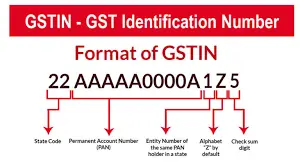
- First two digits: State code.
- Next ten digits: PAN of the taxpayer.
- Thirteenth digit: Entity code based on the number of registrations within a state.
- Fourteenth digit: Alphabet Z by default.
- Fifteenth digit: Checksum digit for verification purposes.
Frequently Asked Questions
GST registration is the process by which a taxpayer gets registered under the Goods and Services Tax. Once registered, a unique 15-digit GSTIN (Goods and Services Tax Identification Number) is assigned.
Rs. 20 lakhs for service providers (Rs. 10 lakhs in special category states) Rs. 40 lakhs for goods suppliers (Rs. 20 lakhs in special category states)
GSTIN (Goods and Services Tax Identification Number) is a 15-digit unique code assigned to every registered taxpayer under GST.
Usually, it takes 3 to 7 working days after submission of all documents and application on the GST Portal.
It’s a simplified scheme for small taxpayers (turnover up to Rs. 1.5 crore) to pay GST at a fixed rate and file quarterly returns.
Yes, if you sell goods or services through e-commerce platforms, GST registration is mandatory regardless of turnover.